
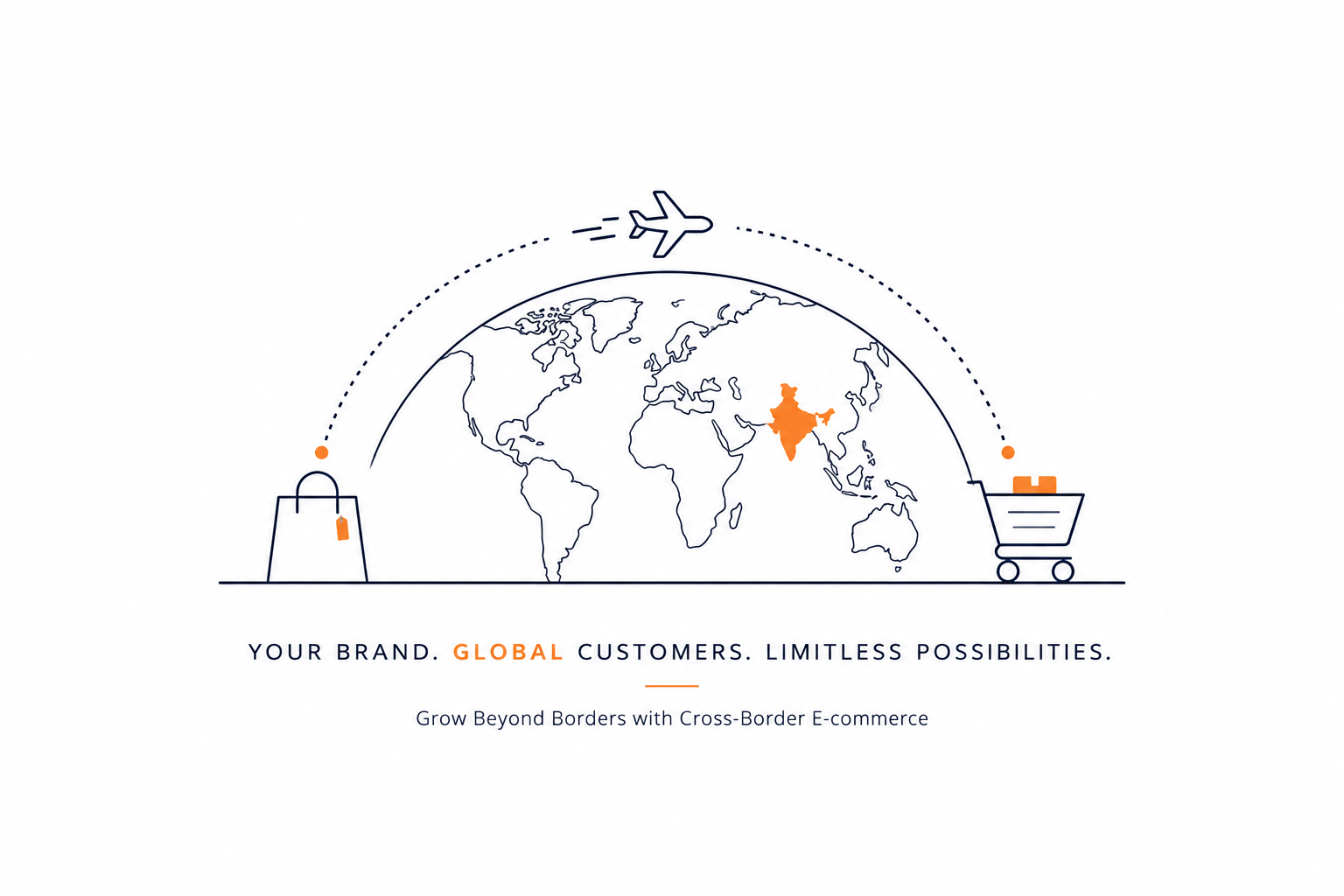
Cross-Border E-commerce. The Next Growth Engine for Indian D2C Brands and MSMEs
Why Selling Globally Is No Longer Just for Large Companies
For decades, exporting was considered a business reserved for large manufacturers with international distributors, overseas offices, and significant capital. Today, that assumption no longer holds true.
Cross-border e-commerce has transformed international trade by enabling businesses of every size to sell directly to customers around the world through online marketplaces and their own websites. Whether you’re a startup, an MSME, or an established D2C brand, global customers are now only a few clicks away.
With platforms like Amazon, Walmart Marketplace, Shopify, Etsy, and eBay, combined with India’s rapidly improving export ecosystem, there has never been a better time for Indian businesses to think beyond domestic markets.
The question is no longer “Can we export?”
The real question is “Why aren’t we exporting already?”
What Is Cross-Border E-commerce?
Cross-border e-commerce refers to selling products online to customers located in another country.
Instead of relying on traditional export channels involving importers, distributors, and wholesalers, brands can directly reach international consumers through digital platforms.
For example:
- An Indian skincare brand selling directly to customers in the United States.
- A handicraft manufacturer from Rajasthan receiving orders from Germany.
- A yoga accessories brand shipping products to Australia.
- A home décor startup from Jaipur selling on Amazon USA.
- A sustainable fashion label delivering products across Europe.
Technology has significantly reduced the barriers that once made international trade difficult.
Why Cross-Border E-commerce Is Growing So Rapidly
Consumers worldwide are increasingly willing to purchase products from international sellers.
Several factors are driving this trend:
- Better international logistics
- Secure online payment systems
- Marketplace fulfillment services
- Increased trust in online shopping
- Demand for unique and authentic products
- Rising popularity of Indian products worldwide
International customers are actively searching for products that are:
- Handmade
- Sustainable
- Organic
- Ayurvedic
- Eco-friendly
- Ethically sourced
- Premium quality
- Culturally authentic
These are precisely the strengths of many Indian businesses.
Why Indian D2C Brands Should Expand Globally
Many Indian D2C brands eventually reach a point where domestic growth slows due to intense competition.
Expanding internationally opens entirely new opportunities.
1. Access Millions of New Customers
Instead of competing only within India, brands gain access to consumers across:
- United States
- Canada
- United Kingdom
- Germany
- Australia
- UAE
- Singapore
- Japan
Each country represents a completely new customer base.
2. Higher Selling Prices
International consumers often pay premium prices for quality Indian products.
Products that sell for ₹1,500 in India may command significantly higher prices overseas, improving profit margins.
This enables brands to invest more in product quality, innovation, and growth.
3. Reduce Dependence on One Market
Depending solely on the Indian market can be risky.
Expanding globally helps diversify revenue across multiple countries, reducing exposure to local economic fluctuations.
4. Build a Global Brand
Selling internationally enhances brand credibility.
Being available on Amazon USA or other global marketplaces increases customer confidence and strengthens brand perception, even within India.
5. Better Inventory Utilization
Cross-border sales help businesses maintain healthier inventory turnover.
Products that may experience slower demand in one market can often find strong demand in another.
How MSMEs Can Benefit from Cross-Border E-commerce
Cross-border e-commerce is not limited to consumer brands.
Manufacturers, artisans, and small businesses can also achieve remarkable growth.
Expand Beyond Local Markets
Instead of relying on regional distributors or trade exhibitions, MSMEs can market products to customers worldwide.
Increase Production Capacity
A larger customer base often leads to higher production volumes, improving economies of scale and lowering manufacturing costs.
Earn in Foreign Currency
International sales generate revenue in foreign currencies, strengthening financial stability and opening new growth opportunities.
Create Employment
Growing export demand requires larger teams for manufacturing, packaging, logistics, customer service, and digital marketing.
As businesses expand globally, they contribute to job creation in local communities.
Improve Product Standards
Selling internationally encourages businesses to adopt better packaging, quality control, branding, and customer service.
These improvements also benefit domestic customers.
Products with Strong Global Demand
Many Indian products are already well-positioned for international success.
Examples include:
- Home décor
- Kitchenware
- Wooden products
- Yoga accessories
- Eco-friendly products
- Organic foods
- Handmade gifts
- Ayurvedic wellness products
- Pet products
- Fashion accessories
- Jewelry
- Leather goods
- Bamboo products
- Sustainable packaging
- Office supplies
- Gardening products
- Festival décor
- Educational products
- Baby products
- Stationery
The key is identifying products with strong demand, healthy margins, and manageable shipping requirements.
Common Challenges Faced by Indian Exporters
Many businesses hesitate because exporting seems complicated.
Typical concerns include:
- Export documentation
- Product compliance
- International shipping
- Customs regulations
- GST refunds
- Pricing strategies
- Foreign payments
- Marketplace registration
- Product listings
- Inventory management
The good news is that these challenges are manageable with the right guidance and systems.
How Technology Has Simplified Global Selling
Today’s digital infrastructure makes exporting significantly easier than it was a decade ago.
Businesses can now leverage:
- Amazon FBA
- Third-party logistics providers
- International payment gateways
- Export documentation software
- AI-powered product research
- Inventory forecasting tools
- Digital marketing platforms
- Global fulfillment services
Many operational tasks can now be automated, allowing entrepreneurs to focus on product development and customer experience.
Government Support for Exporters
The Indian government has introduced multiple initiatives to encourage exports.
Businesses can benefit from:
- MSME support programs
- Export promotion councils
- DGFT services
- Export incentives (subject to applicable schemes)
- Digital documentation
- Trade facilitation initiatives
- Skill development programs
These initiatives make international expansion more accessible than ever.
How to Get Started with Cross-Border E-commerce
Starting your global journey does not require a massive investment.
A practical roadmap includes:
Step 1
Identify products with international demand.
Step 2
Research target countries.
Step 3
Understand compliance requirements.
Step 4
Obtain the necessary export registrations.
Step 5
Choose the right marketplace or launch your own international website.
Step 6
Optimize product listings with high-quality images and compelling content.
Step 7
Select an appropriate fulfillment model.
Step 8
Monitor performance and scale based on customer demand.
The Future Belongs to Global Indian Brands
India is emerging as a global manufacturing and innovation hub.
Consumers around the world increasingly appreciate products that combine quality, authenticity, and value. This creates an ideal environment for Indian D2C brands and MSMEs to establish a strong international presence.
Businesses that embrace cross-border e-commerce today will be better positioned to build resilient, globally recognized brands over the coming decade.
Final Thoughts
Cross-border e-commerce is more than just another sales channel. It is a strategic growth opportunity that enables Indian businesses to reach new customers, diversify revenue, and compete on a global stage.
Whether you are a startup, an MSME, or a rapidly growing D2C brand, the world is more accessible than ever before. With the right products, effective branding, reliable logistics, and expert guidance, international expansion can become a realistic and rewarding next step.
The businesses that act today will shape the next generation of global Indian brands.
How Niryat.in Can Help
At Niryat.in, we help Indian D2C brands, manufacturers, and MSMEs successfully expand into international markets through cross-border e-commerce.
Our services include:
- Export readiness assessment
- Product selection and market research
- Amazon Global Selling support
- International marketplace onboarding
- Export documentation guidance
- Product listing optimization
- FBA and fulfillment consulting
- Compliance assistance
- Growth strategy for global expansion
Whether you’re taking your first step into exports or looking to scale internationally, Niryat.in provides the expertise and support to help your business grow beyond borders.
From India to the World. Your global journey starts here.