
For years, Amazon was considered one of the most profitable marketplaces for ecommerce businesses. Sellers could leverage Amazon’s massive customer base, fast fulfillment network, and Prime membership ecosystem to build highly successful businesses.
However, the landscape is changing.
Today, one of the biggest concerns among Amazon sellers is not finding products or generating sales. It’s managing profitability.
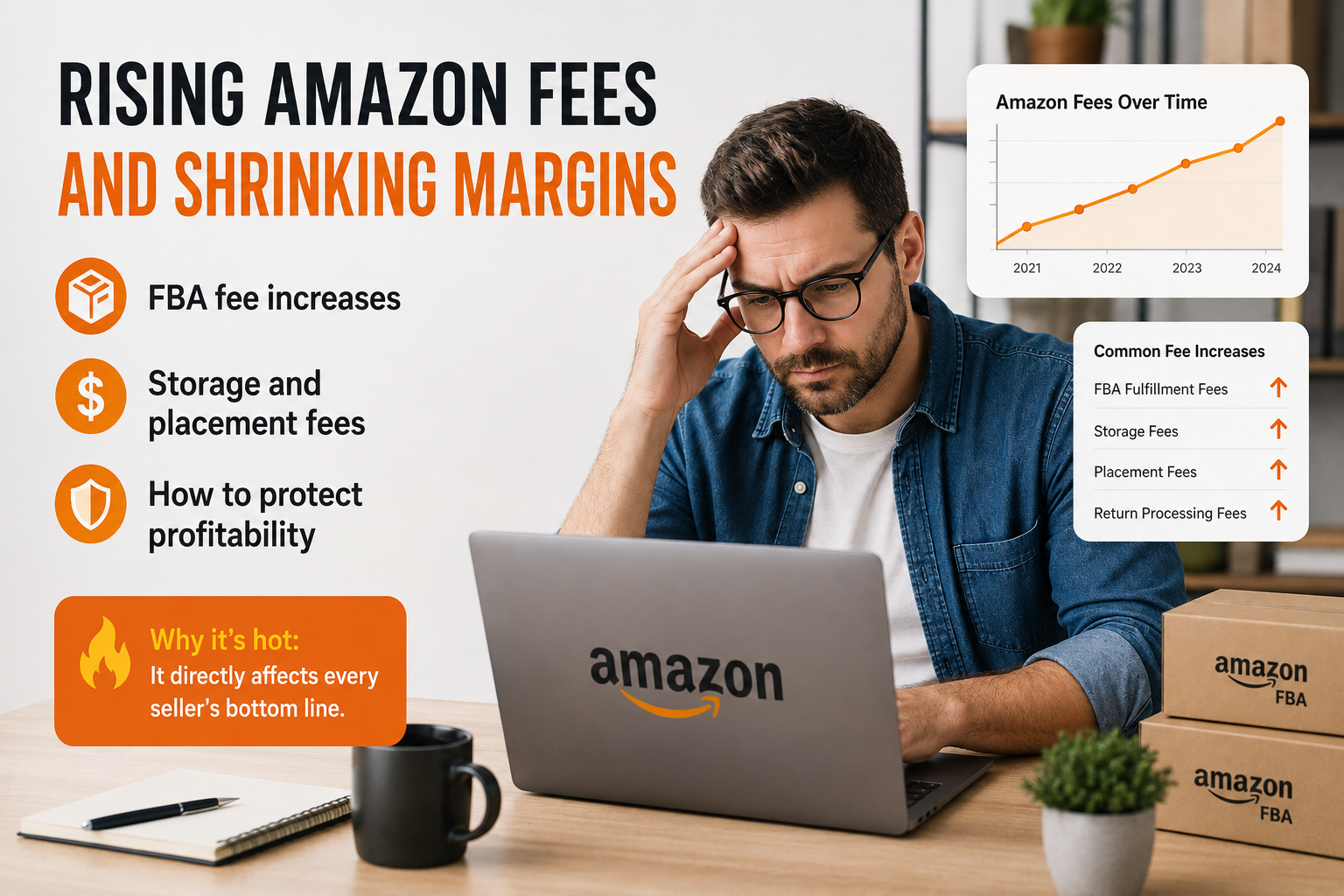
Rising Amazon fees and shrinking margins have become a serious challenge for both new and experienced sellers.
Increasing costs in:
- FBA fulfillment fees
- Storage fees
- Placement service fees
- Advertising costs
- Returns processing fees
- Warehousing and logistics
are eating into seller profits like never before.
The big question is:
Can Amazon sellers still build profitable businesses in 2026?
The answer is yes, but only if they adapt.
This guide explains the latest fee trends and practical strategies to protect your bottom line.
Table of Contents
- Why Amazon Seller Margins Are Shrinking
- Understanding Amazon FBA Fee Increases
- Rising Storage Fees and Inventory Costs
- The Impact of Placement Service Fees
- Hidden Costs Most Sellers Ignore
- How to Protect Your Profitability
- Profitability Calculation Framework
- Frequently Asked Questions
- Final Thoughts
Why Amazon Seller Margins Are Shrinking
Five years ago, many sellers operated with profit margins between 25% and 40%.
Today, many businesses struggle to maintain margins above 15%.
Several factors are responsible:
- Increased Amazon fees
- Higher advertising costs
- Intense competition
- Inflation and rising manufacturing costs
- Increasing shipping expenses
- Higher return rates
As a result, many sellers are generating more revenue while earning less profit.
Understanding Amazon FBA Fee Increases
Fulfillment by Amazon (FBA) is one of the biggest advantages of selling on Amazon.
However, it is also one of the largest expenses.
What Are FBA Fees?
FBA fees cover:
- Picking and packing
- Shipping to customers
- Customer service
- Returns processing
- Storage within Amazon warehouses
As Amazon’s logistics network expands, operational costs have increased, and many of these costs are being passed on to sellers.
Why FBA Fee Increases Matter
Even a small increase in fulfillment costs can significantly impact profitability.
Example
Product Selling Price: $40
| Expense | Before | After |
|---|---|---|
| Product Cost | $12 | $12 |
| Amazon Referral Fee | $6 | $6 |
| FBA Fee | $5 | $6 |
| Advertising | $4 | $4 |
| Profit | $13 | $12 |
A one-dollar increase in fees may not seem significant, but across thousands of units, it can reduce annual profits substantially.
Storage Fees Are Becoming a Major Profit Killer
Inventory management has become more important than ever.
Amazon charges sellers for storing inventory in its fulfillment centers.
Storage fees increase during peak seasons and can become extremely expensive for slow-moving products.
Types of Storage Costs
Monthly Storage Fees
Charged based on:
- Product size
- Cubic feet occupied
- Time of year
Aged Inventory Surcharges
Applied when inventory remains in Amazon warehouses for extended periods.
This is one of the biggest reasons sellers lose money.
Common Inventory Mistakes
Many sellers:
- Over-order inventory
- Miscalculate demand
- Ignore seasonal fluctuations
- Fail to remove slow-moving products
As a result, storage fees gradually erode profits.
Understanding Amazon Placement Service Fees
Placement service fees are one of the newest concerns for Amazon sellers.
Amazon may charge sellers when inventory is sent to fewer fulfillment centers instead of multiple warehouse locations.
The objective is to distribute inventory more efficiently across Amazon’s network.
For sellers, however, these fees can create additional costs.
Why Placement Fees Matter
They directly affect:
- Profit margins
- Inventory planning
- Cash flow
- Replenishment strategies
Businesses operating with low margins are particularly vulnerable to these additional expenses.
Hidden Costs That Most Sellers Ignore
Many sellers focus only on product cost and FBA fees.
However, several hidden costs significantly impact profitability.
1. Return Costs
Returns can:
- Damage inventory
- Increase processing expenses
- Reduce profit margins
Some categories experience return rates exceeding 10%.
2. PPC Advertising Costs
Amazon advertising costs continue to rise.
Many sellers now spend between 10% and 20% of revenue on advertising.
Poor campaign management can quickly destroy profitability.
3. Long-Term Storage Costs
Unsold inventory ties up cash and generates additional fees.
Inventory that doesn’t move is often more expensive than sellers realize.
4. Currency Fluctuations
International sellers face:
- Exchange rate risk
- Payment conversion fees
- International banking charges
These expenses often go unnoticed until profits begin shrinking.
How to Protect Your Profitability on Amazon
The good news is that sellers still have several ways to maintain healthy margins.
1. Improve Product Selection
Avoid products that have:
- Extremely low prices
- Thin profit margins
- High return rates
- Large dimensions
- Heavy weights
Instead, focus on products that offer:
- Healthy margins
- Strong demand
- Low competition
- Efficient shipping economics
2. Increase Average Selling Price
Products priced under $20 often struggle to absorb increasing fees.
Higher-priced products generally provide:
- Better margins
- More flexibility
- Greater profitability
3. Optimize Inventory Management
Inventory management has become a competitive advantage.
Best practices include:
- Accurate forecasting
- Smaller, more frequent shipments
- Faster inventory turnover
- Removal of aged inventory
4. Reduce Advertising Waste
Many sellers waste thousands of dollars on poorly optimized PPC campaigns.
Regularly:
- Eliminate non-performing keywords
- Reduce unnecessary bids
- Focus on profitable search terms
- Monitor TACoS and ACoS
5. Negotiate Better Supplier Pricing
Even small reductions in product cost can significantly improve margins.
Strategies include:
- Volume discounts
- Better payment terms
- Supplier diversification
- Packaging optimization
6. Improve Conversion Rates
Higher conversion rates lower advertising costs.
Ways to improve conversions:
- Better images
- Optimized listings
- Enhanced A+ Content
- Stronger reviews
- Improved product descriptions
7. Monitor Every Cost
Successful sellers track:
- Contribution margin
- FBA fees
- Advertising costs
- Refunds
- Return expenses
- Storage charges
- Shipping costs
Data-driven decisions are now essential.
The New Amazon Profitability Formula
Many sellers focus only on revenue.
Smart sellers focus on profit.
A simple profitability formula is:
Net Profit = Revenue – Product Cost – Amazon Fees – Advertising – Logistics – Returns – Overhead
The businesses that monitor every variable usually outperform those chasing revenue alone.
Signs That Your Amazon Business Needs Immediate Attention
You should review your business if:
- Sales are increasing but profits are declining.
- Inventory turnover is slowing.
- Advertising costs are rising rapidly.
- Storage fees continue increasing.
- Cash flow is becoming tight.
These are often early warning signs of margin compression.
Frequently Asked Questions
Are Amazon FBA fees increasing every year?
Amazon regularly adjusts its fee structure to reflect operational costs and changes in its fulfillment network.
What are Amazon placement service fees?
These are fees associated with how inventory is distributed across Amazon’s fulfillment centers.
How can I reduce Amazon storage fees?
Improve inventory forecasting, remove aged inventory, and avoid overstocking products.
Is Amazon still profitable in 2026?
Yes. However, profitability depends heavily on product selection, inventory management, and cost control.
What is the biggest threat to Amazon sellers today?
For many businesses, the biggest threat is shrinking profit margins caused by rising fees and increasing competition.
Final Thoughts
Rising Amazon fees and shrinking margins are now a permanent reality of selling on Amazon.
The days of easy profits and inefficient operations are largely over.
The sellers who will thrive in 2026 and beyond are those who:
- Understand their numbers
- Monitor profitability closely
- Optimize inventory
- Control advertising costs
- Adapt quickly to Amazon’s changing fee structure
Revenue is important.
But in today’s Amazon marketplace, profitability is the real competitive advantage.
Businesses that focus on protecting margins will continue to grow, even as costs rise.
About Niryat.in
At Niryat.in, we help Indian brands, manufacturers, and Amazon sellers expand globally through Amazon USA and other international marketplaces.
From Amazon account management and listing optimization to wholesale sourcing and ecommerce exports, we help businesses build profitable global brands.
One Click Export. Chalo Export Karein.